Monday, August 29, 2011

Polish Trains

Although I have spent a good deal of time in Poland, this year was my first time navigating the unbelievably complicated wonder that is the Polish railways system on my own. While most counties have one national service provider, Poland has two. The first , PKP, is a subsidiary of the national railways, while the other Przywozy Regionalne, is a private company and often the cheaper of the two. PKP sells tickets for both companies. There are also PR offices, which only sell PR tickets. To further complicate matters, there are multiple kinds of tickets for each company. From my travels this year here are some of the things I have learned the hard way about the Polish train tickets:
• Even if the signage says otherwise, PKP always sells ‘Regio’ tickets.
• If you buy a ticket from one company for the other it will still be printed on in the boarding card of the company you bought it from. Don’t let this fool you. The actual company and kind of ticket is denoted by unintelligible codes printed on the ticket.
• ‘Osobowy’( train with no seat reservations) tickets are cheaper. However, because all PR tickets are Osobowy, simply asking for one implies that you want a PR ticket. If you want a non inter-city PKP train, you need to specify this. In general it is a good idea to clearly specify the exact kind of ticket you want. If you are not picky about price, it is often just easiest to ask for a ticket on the next train to you destination.
• When you screw things up, you will be made to pay a fine and buy a new ticket. the conductor from the other company can stamp the old ticket so that this other company will redeem a percentage of its value. If you speak Polish, the conductors will be more then happy to explain what you did wrong and will usually take the time to explain the company codes to you.
• Many people just buy the ticket once they get on the train. When I tried this one conductor warned me that you have to pay a 10 zlotych fine if the ticket counter in the station you left from is open. I don’t know how they know if it is, but apparently they do.
• Just paying the 10 zl fine is better then getting caught with the wrong ticket.
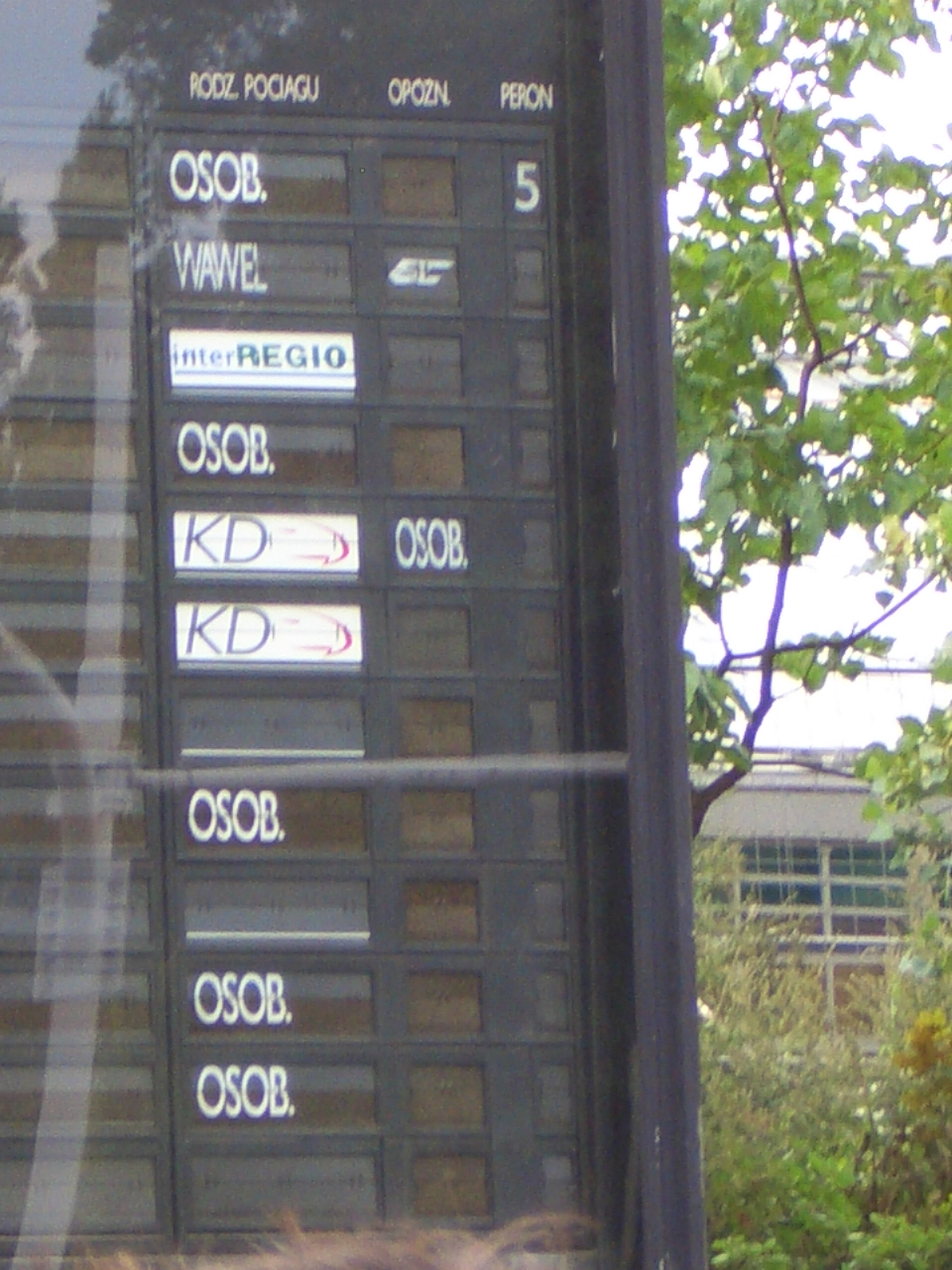
On the day I was traveling from Poznan to Wroclaw, PR employees decided to go on strike. Instead of negatively affected, I found myself grateful that I only had to deal with one company. When I got to Wroclaw, I noticed that there is yet a third train company which operates in the Wroclaw area. To make matters worse this company sometimes runs combined trains with PR. There were so many kinds of trains that the lateness colum on the arrival/departure board, had to be co-opted in order to delineate all the different kinds of trains. If the train is late, as in Poland they often are, it reverts to showing arrival times, and you just have to guess what kind of train it is.

Wednesday, August 17, 2011

Perspectives on Nowa Huta

29 years ago my mother traveled to Poland as a journalist, to cover the country under martial law. She spent the Christmas vigil with a family in the infamous communist housing complex of Nowa Huta. I grew up hearing Nowa Huta essentially described as the epitome of all that was wrong in communist Poland. So, despite having been to Krakow three times, it was not until a few weeks ago that worked up the courage to take the tramwaj out to this section of the city.
What I found there surprised me. I had heard up to that point Nowa Huta was still one of the poorest and ugliest parts of Krakow. However, I found a well kept development, free of any obvious poverty. Compared to other block housing developments I have visited in Romania and Moldova, the buildings in Nowa Huta are in good condition. Graffiti, prolific in many parts of Poland, seemed to be kept to a minimum.
Despite the city’s current condition, reminders of its troubled past are still everywhere. It’s not that the scars of socialist era have yet to heal. The development was originally conceived as a model socialist utopia, but the present day residents of Nowa Huta seem to enjoy finding new and creative ways of giving the finger to the Bolsheviks. You pass from streets such as Solidarity Avenue to Pope John Paul II Street. The statue of Lenin which once dominated Nowa Huta’s Plac Centralny is conspicuously absent, replaced on the far end of the square by a monument to the Solidarity movement. A chapel has been consecrated on the site where the government's refusal to allow the residents to build a church incited riots. The cross originally in the field is now a monument. One of the inscriptions on the cross, a quote by Pope John Paul II reads “ from the cross in Nowa Huta began a new evangelism, the evangelism of a new milennium.” It was amazing to know that I was standing one of the spots where Poles began their fight for freedom.
With these thoughts in my head I decided to stop in at a café on the main square before heading back to Krakow. Soon after I sat down, one of Nowa Huta’s senior citizens, a resident of 50 years, entered and asked if he could sit with me. We began talking about how the city had changed. “Everything works now,” he opined, “but these days we lack community.” He proceeded to tell me of late nights at the cinema, and dancing until dawn in the city’s famous Restaracja Stylowa. "It was truly beautiful,” he added, “ but young people these days are only interested in new things.” His statement made more sense when my teacher later explained that the entertainment of which he spoke of were events organized by the communist party. Restaracja Stylowa is still there, but is now a tourist attraction that caters to communism tour groups. The way the old man in the café spoke of it, it sounded like it had closed long ago. For him , it may well have.


Friday, August 5, 2011

A Chilling Saturday

This is my fourth time in Poland. However, it was not until last weekend that circumstances allowed me to pay my respects at the camps of Auschwitz and Birkenau. Needless to say that it was a powerful experience. I have been to Dachau and Majdenek, but I was totally unprepared for the gravity of the location, just outside Krakow. Judging by my past experiences I was expecting a series of sagging wood shelters. Birkenau did fit this description, but because Auschwitz was originally an Army barracks, it consists of a conglomeration of finished brick buildings. If one did not know what had taken place there, it would have looked like just another set of early 20th century apartment buildings. What did occur was more horrific than at any of the other camps I have visited. While listening to stories of medical experiments and intentional mass extermination, I was shocked that human beings could be capable of such tasks. The camp commandant and his entire family even lived next to the gas chambers.

At many points around this living monument there were donation boxes for the restoration of the site, which apparently is falling into disrepair. I can only hope that these camps continue to stand as a monument to those who perished, and a reminder to never let such a tragedy happen again.

The Party That Never Ends

Roughly a week after the start of my arrival in Poland, the organizers of our language program announced that there would be a tour of of the city's old town. While I have been to Krakow many times I decided that this would be a good way to meet some new people, so I signed up. Instead of information about the old town's history, I had a discussion which I found to be somewhat shocking.
While on the tour I met a girl from Madrid, who eagerly asked me about the portrayals of American high school, which she had seen in Hollywood movies. According to her sources, the main goal of everyone in everyone in high school was to become either "a football player or a cheerleader." When I informed her that I and most students at my high school were much more concerned with getting a prefect score on the SAT and gaining admittance to a good university, she seemed almost to blame me for not living up to the unrealistic stereotypes set by popular western culture.
This experience highlights two negative ways in which exported American popular culture may influence those who consume it without any knowledge of actual life in the U.S. First: the obvious misrepresentation of real America. Second: the increasing tendency of a few Europeans to criticize Americans, for not living up to these same expectations.
While most Europeans I have met are honored by my goals of a career in eastern Europe, I have also met my share of those who respond by questioning why I would want to leave a country which in their view is free of problems and consequences. This in not their fault. Even in the smallest Polish towns the inhabitants are bombarded with a near-constant stream of media with such a theme. On the radio most American songs are about parties that never end in various American cities, while the most popular Polish one is about calling off a wedding at the last minute. Many Americans who come to Europe are on vacation and do party every night. It is only logical that some are going to draw the conclusion that this is an accurate representation of life in America.
As an American overseas, this can sometimes be frustrating. It is all I can do to say that America is a country with it's share of problems - like any other. It is up to the representatives of America abroad to set the record straight by providing a dignified, but accurate portrayal of life in their country.

Friday, July 8, 2011

Greece: Crisis Averted?

During my most recent stint of travel, I had the opportunity to spend a day in Greece. While this country has not been in the news for a few weeks, I still feel it necessary to put in my two cents regarding the economic situation there. Admittedly, I was only there a small amount of time. However, I was immediately impressed upon my arrival at the contrast between the amount of private wealth in the area, and the obvious signs of a bankrupt government. Once you leave the old town of Rhodes, there is new construction everywhere. Many of the cars are luxury brands. On the other hand, almost all of the government run historical attractions on the island were closed until further notice. Many ancient ruins which are falling into unceremonious disrepair.
While the closed, dilapidated historical attractions did suggest the imminence of a debt crisis, it is important to remember that much of the private growth is being propped up by public spending. Any meaningful attempt at austerity would mean a great reduction in Greece' s standard of living. As a result, it is easy to see why there have been in the past, threats to recall any Greek member of Parliament who votes for such measures.
Since my visit, the Greek government did finally manage to obtain some agreement regarding austerity, in return for an EU relief package. However, it remains to be seen whether the government will follow through with their promise of responsible spending.
Even though an imminent debt crisis seems to have been averted for the time being, it has been my experience that people from euro zone countries have stopped trusting Greece, and in many cases the euro. Many either do not trust Greece to follow through on it's obligations, or have expressed regret that their country in the euro zone.
With the economic issues I had seen exemplified on the island of Rhodes still fresh in my head I left the Mediterranean for Krakow. Shortly after my arrival I found myself discussing the situation with a Slovak woman over dinner. "The dollar was so strong that we were happy to get the euro" she told me in Polish " Now Slovakia must pay for Greece's spending.

Thursday, July 7, 2011

Traveling through Turkey

I am currently in Poland and it has been a while since I have had time to blog. So before I forget some of the things I did while in Turkey I think it best to write them down and post.

On the first day in Istanbul, I set out to see the Blue Mosque with my family. It was here that we got our first introduction to how creative pushy salesmen can be in Turkey. Upon entering the mosque we were immediately accosted by a carpet salesman. He told us something about the history of the place and then insisted multiple times that we buy one of his carpets, even after we outright refused. This type of behavior was a problem throughout most of Turkey. It was impossible to stop at a restaurant or souvenir shop without being accosted. They only other place where I have encountered this type of hard sales technique has been in China. In my opinion this method of advertising can backfire, as we made a point of going only to the few restaurants that did not hassle us.

After while in Istanbul we also toured Hagia Sophia and many of the other mosques in the Sultanahmet area, as well as the Topkapi Palace.

The next stop on the trip was Cappadocia. It was a rather quick change of pace going from the bustling city to the the contorted fairy chimneys of Goreme. In many ways the small town was the exact opposite of Istanbul. The locals realize the tourists are their livelihood, and treat them with general respect. Even pigeons, which are considered to be nuisances in most major cities, are prized in Cappadocia for their soil-enriching droppings. It was interesting to see the plethora of different kinds of tourists that pass through this part of central Turkey.

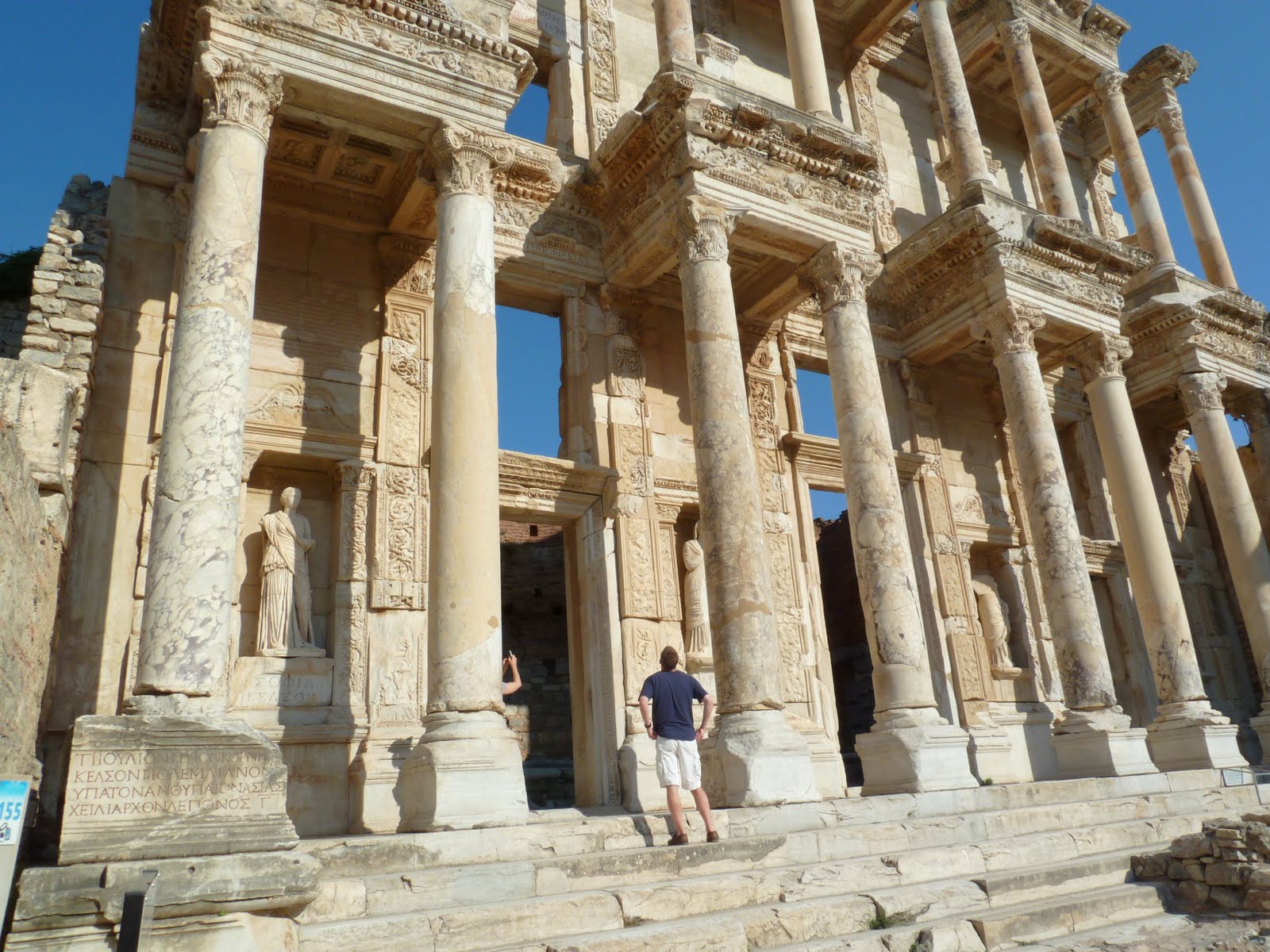
During the next part of the trip we traveled down the so-called Turkish Riviera, starting near the world heritage site of Ephesus. As a Catholic it was an amazing experience to go to holy sights, In this part of Turkey, including where St. John wrote his gospel, and the last residence of the Virgin Mary. We continued down the coast in searing heat, stopping to look at many ruins, to Bodrum, where we decided to go scuba diving. While the cargo plane we dove on was interesting, the reefs on the Turkish cost are rather dead, and thus don't attract many fish.

One of my favorite places on this trip was the small fishing village of Turunc, near Marmaris, a mess of a commercial tourist town. Turunc is popular with Polish and Russian tourists, so I had fun practicing with them while there. during this time we also spent a day on the Greek island of Rhodes. The old town was amazing. After having this experience I hope to go to Malta or some similar location.

From this point we continued south along the Mediterranean coast to Kas. While here we took a kayaking expedition over an ancient sunken city, one of the most interesting things I have ever done. The tour ended in a small, very undeveloped town. While the Lycian tombs in the area were interesting. one of the most amazing things I saw were the children stationed throughout the town, peddling various bracelets or articles of clothing. When someone was even remotely interested in the merchandise, other children who were previously on the other side of the town would quickly appear to compete for business. I have no idea how they know when someone they cannot see is interested in buying. Many of them also need a lesson in western business, as they seem to think that "getting there second" is a good selling point.

After a night in Antalya, we returned to Istanbul. There was an opera festival going on there. I decided to avail myself fully of the Turkish state opera's offerings. The first opera we saw was Rossini's "Mehmet the Second'. While the music was rather pedestrian, the spin that the Turkish opera put on it was quite impressive. The opera had the largest cast I have ever seen, complete with horses. The staging was unmatched insofar as sheer grandeur. I found the decision of the directors to stop the scored music, and have the Sultan make his entrance the way he actually would have, accompanied by the actual guard and band from the Topkapi palace, to be quite interesting. It was well the trouble to see this opera, in an outdoor amphitheater, during a rainy night. I also saw a Modern Turkish opera, in the Topkapi palace. It was interesting to see how the composer reconciled the conventions of western music composition with the technicalities of the Turkish language.

On our last day in Turkey, we found ourselves returning to the Blue Mosque. I found that after a month in this unique country. I looked upon it with greater appreciation.

Sunday, July 3, 2011

At-A-Turk

About three years ago I spent some time working in the Maldives, an Islamic republic where alcohol is forbidden and dogs are banned from the entire country. So, on my first night in Turkey, another largely Muslim nation, I was supprised to find myself on a roof terrace admiring the Blue Mosque, sipping a glass of wine, while the puppy on the roof next door howled in harmony with the sounds of the call to prayer. During my time in Turkey I learned that I could have this experience in the Turkish republic thanks to the country's founder and first president, Ataturk.
Apparently Ataturk founded the republic with the vision of a secular Muslum nation with strong ties to the west. While this may seem like somthing of a contradiction in terms, in practice the country runs rather well. In general people seem to have the freedom to be as devout or as casual about religion as they choose. On the streets the result is clearly visible; women covered in burkhas or wearing hijabs brush elbows with women in western dress, and Biblical relics that are also revered by Christians are displayed in Topkapi Palace alongside artifacts of the Muslim faith.
That said, Turkey still has its Muslim priorities. Most of the beer for sale is made by Efes, a tightly held beer monopoly, and all other forms of alchohol are heavly taxed. There seems to be a priority in the entire country for restoring Islamic holy buldings, while letting Greco-Roman and Christian ruins fall to dust. UNESCO and other organizations have stepped in to help restore some of the more prominent Byzantine attractions such as Santa Sophia, this is not the norm in the entire country. In Goreme, an old woman even showed as a medieval church with decaying frescos, which was being unceremoniously used for grain storage. At first, I questioned the wisdom of this attitide, but then I remembered that many European countries from hungary to Spain, have been slow to restore mosques that were converted into churches.
I heard many Turks speak of their loyalty to the principles of Ataturk, the founder of the Turkish Republic. A hotel owner in Capadoccia told us that he made political decisions based on how much the polititians keep the country "on the way of Ataturk." It is also illegal to speak negatively of Turkey's first president in public. During the month I spent in the country I learned that this law is actually quite intelligent, as it seems to be in place with the aim of catching extremists and other dissenters before they can do violence. From what I observed, most of the country appears to genuinely respect Ataturk.
On our last day, in Turkey, we visited the bedroom where Ataturk died, at the early age of 57. When we asked the cause of his death, the tour guide simply told us that it was "too much smoking and drinking." There was no hint of malice in his voice.