Showing posts with label travel. Show all posts

Monday, January 27, 2014

The Narrative of Self

I’ve decided to take a break from blogging for a while. As I entered the second year of my Master’s program taking time to think seemed appropriate. Questions begged themselves: Where should I go from here?  What’s next?
 I won’t claim being any closer to definitively allaying such molestations as I write this. What I will do is attempt to give some modicum of organization to the last few months. Its story begins with a class that everyone seemed to hate.
The professors were younger. At least for most in their position. They were also rigid; they insisted we complete assignments for the required theoretical and methodological seminar on a topic pertaining to their field of study: Africa and Latin America.
 Like most of my classmates I was not happy. Fortunately, I was granted reprieve to develop the assignment in one of my current research areas. But, I also had a back-up plan. I knew that many 19th century works of Polish authors wrote variations on gawęda szlachecka. This literary form reflects narrative patriotic/religious ideals of moral-courageousness as exemplified by Polish gentry amid invasion. Sometimes, these novels focus on sanctimonious civilization of the Subaltern by Polish certitude  (for a famous English language example, The Heart of Darkness somewhat qualifies). Poland was partitioned at the time. The colonial ‘export’ of the gawęda’s setting served as a metaphor of Polish cultural actualization amid their own colonizers’ attempts at forcible integration.
 But, this gawęda didn't go with the end of empire. It adapted with the imposition of communism. I found one Polish writer who’d been to Africa and Latin America: Ryszard Kapuściński. I began reading one of his books, ‘Christ with a Rifle on His Shoulder’, on the way to my program’s winter school. It detailed revolutionary movements of the displaced on each of the southern continents.  Frankly, I found the work mostly one sided and do not agree with many of its views.
Still, it made for fascinating reading.  This author traveled the world. He detailed conceptualizations of community in Palestinian camps.   He also deconstructed accounts of political coups. I sat open-mouthed as I read of an armed conflict between student groups on university grounds in Bolivia. Other than permanent closure of the university, the government had no way to stop student conflict or protest. Even the rector was powerless. This was a car cry from the student protests of professorial power to which I was accustomed. As Kapuściński writes: there, "the students decide about everything”. Conflict still occurs.     
Back at winter school, a student from La Paz told me that extremist politics were still visible at that university. Though to a less violent extent.  At the same time, she was critical of her country’s indigenous president. As leader who controlled the country, she felt he'd failed to accomplish positive reforms.
The indignation didn’t end with South American politics. A few students of our own program attempted their own rebellion later that night. They objected to opaque standards of awarding merit scholarships on the program. That distribution was far from achievement’s entitlement.  This ‘movement’ was met by the recipients’ with decisively weak opposition. They won; there’s no stigma attached to success. No matter your views regarding it's legitimacy. Yet, the act of protesting authority and resulting resistance to it grants a sense that one is in the right; in this respect one's side is unimportant.     
One of my friends in Vienna finally got here a month ago. She’s on my program. But, Austria wouldn't grant her the visa until recently. Shortly after her arrival she told me what she had learned from the experience: “No one can make you feel inferior without your consent”. However, self-conviction  requires confidence. An almost religious commitment to forging one's own auto-narrative exceptionalism. Despite damaging actions of others. 
In that, maybe there is actualization in claiming aid for—or power over—those you perceive to need it.   There’s a comfort in finding righteousness amid your own uncertainty. Especially when fear of the future failure remains in your own small successes. And when there's resentment in knowing some have achieved more with less effort.
I attended high mass in Vienna’s cathedral five years ago. Last Sunday I returned. On both arrivals I felt as if my future was less than certain, or bright. Upon leaving, I felt I'd found some unknown certainty  to gain. That gave me hope. It also scared me.  
Superiority and inferiority are relative. So are opposing political beliefs. So are right and wrong for that matter. When one of them ascends into in popular favor, how can you be sure which side you’re on? 
Could it be that’s how Gawęda Szlachecka still lives? By fulfilling our fear of uncertainty. By giving us the power to adapt to an ideology of the moment through refusing to be made subjectively inferior; often by placing others in that category. By envisioning a sure way forward free from validation. One which is one's own.
Could it be? And, if so, which way is it? 
I end this post with the above questions. 

Tuesday, June 25, 2013

Pitfalls of Reputation

Guidebooks are notoriously inaccurate. That’s one of many things I’ve learned throughout my travels. They incorrectly state the opening hours of main attractions. They give many sights an undeserved build-up.  They unjustly decry others as not worth visiting. Guidebooks also make or break reputations.  
Countries have reputations as well. As I researched my long weekend in Ireland, one travel guide conceded that Ireland is one country which evokes high expectations. The travel manual was correct in this supposition. After five months in Wroclaw I was ready for a change. My vision of the Emerald Isle certainly qualified.

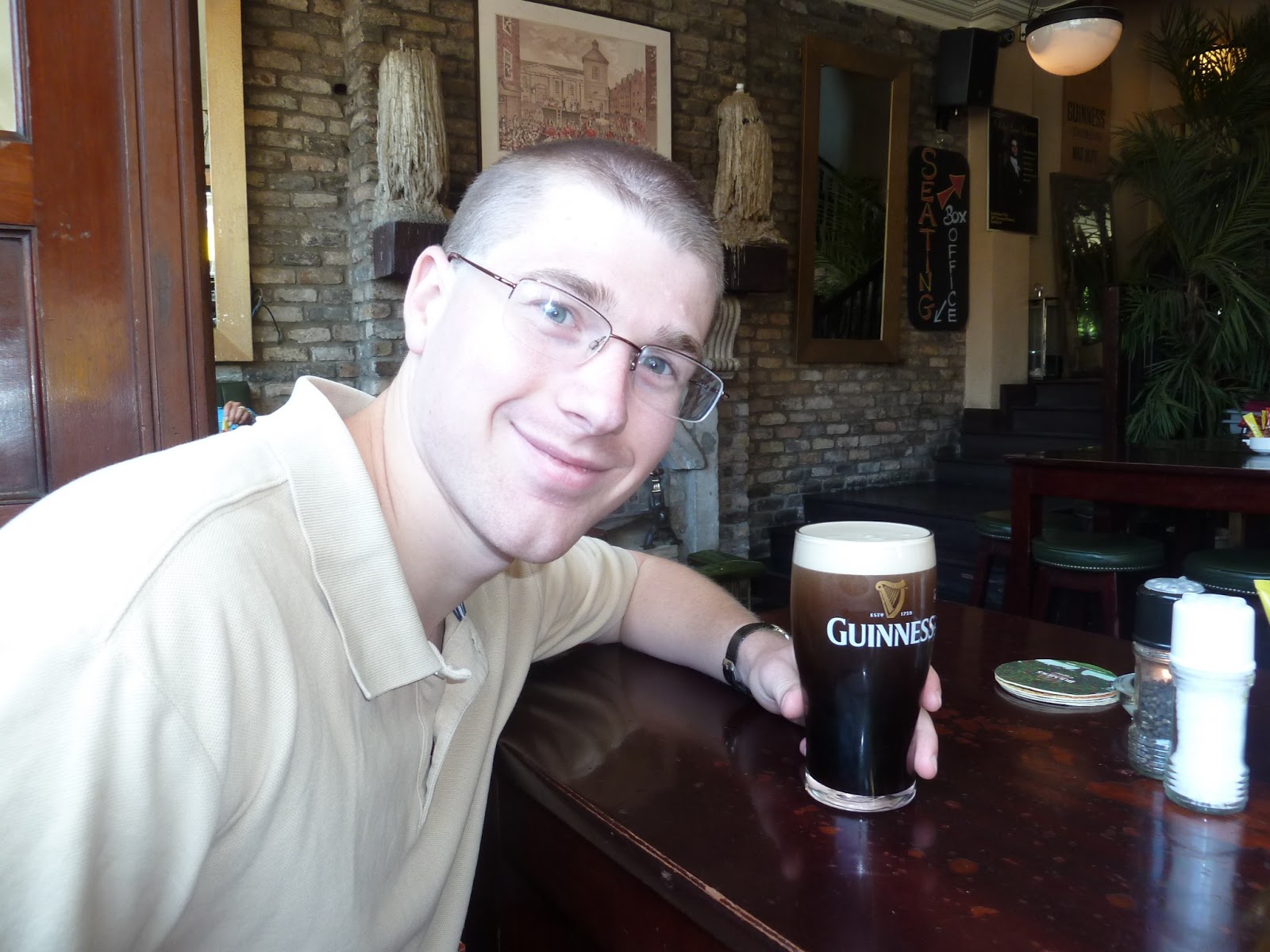
A friend and I decided to spend a few days in the country. The shock began shortly after arrival in Dublin. The reception at our hotel was a pub’s bar. This was convenient. However, it was also the beginning of sticker shock.  I enjoyed a couple of ales as I waited for my friend’s arrival. Each was almost 5 Euros.  
 You don’t get more for your money either. One is expected to pay through the nose for services of medieval quality. On buses you’re expected to have exact change. The fare depends on your destination. Bus drivers are far from patient. Attractions and food are also far from cheep.
Ireland has a reputation for friendly locals. We had a mixed experience. On the street, many will offer to give you directions.  The natives can be downright abrasive when acting in a professional capacity. We got lost on our way to Kirkham Jail. Some off-shift construction workers offered to help us find our way. We tried again to board public transport. Company employees yelled at us when we failed unwittingly to join an unnecessarily single-file line.
Our guidebook highly recommended the Guinness ‘Storehouse’ as a top attraction. It was one of the stupidest sights I’d ever seen. I’ve visited actual breweries before. This exhibit displayed computer generated models of the beer’s elaboration. The company attempted to sell you something at every step of the process.  
That evening I returned to the hotel’s reception-bar. Some Brits asked if they could join me as they polished off a bottle of wine. We discussed pubs and culture in Ireland and UK. Prices have generally skyrocketed in Ireland since it joined the Eurozone.  My British acquaintances informed me that UK is now less expensive in many cases.  I also asked them why so many pubs are going out of business. They pointed to a generational divide.  My parent’s generation went to the local pub to see friends. ‘You have your Ipads’ one of them told me. They mentioned the economic situation as well. The era of easy credit is over. Going to a pub is an unimportant luxury.
We headed for Cork after two days. The guidebook asserted that the city was of interest.  It turned out to be a boring version of Pasadena. After ringing the bells at the ‘Four Faced Liar’ clock tower  there was nothing left to do. The guidebook negatively described Ireland’s famous Blarney Castle.We decided to go anyway for lack of a better idea.
It turned out to be the best sight we saw on the entire trip. For some reason, the day was light on tour groups.  It isn’t just a castle with a famous stone.  We enjoyed walking its extensive grounds. I’ve read that there are more impressive sights in Ireland’s country side.
Maybe the guide books were partially correct.  Perhaps we saw the wrong parts of Ireland.  Its reputation may be defined by the countryside. But, that is not the Ireland I saw.

My flight back to Poland was full. Mostly with emigrants returning to visit their families. A middle-aged Polish lady joined me as I looked up the night bus schedule near the airport.  She explained that she could barely speak English as she bought her ticket from an automat. She’d worked in an Irish factory for 8 years.  We spoke Polish as the communist-era ‘Jelcz’ bus lumbered through early morning Wroclaw. It was so normal. Almost relaxing. I didn’t need a guidebook.  I was home.  


Friday, May 17, 2013

On The Stress of Travel and Being


 Everything has an end point. An apex.  A rock bottom. That place where the only direction you can go is down or up. Or maybe nowhere at all.
One of my many nicknames is The Prize Winning Travel Pig named Andrew. The etymology of this in-joke is lengthy. Suffice it to say that it refers to an ability to win competitions: admissions and awards which are conducive to continued travels.
When I arrived for grad school in Wroclaw, I expected to settle well into local life. My summer internship in Thailand and Cambodia had been one of my more trying positions. My home-stay in Pakistan was an eye opening but uncertain adventure.  It was time to head back down. I know and love Poland. Travel there would be like coming home to a different world.
Then I got called away to Slovenia for citizenship matters. Twice to Ukraine for scholarship reasons. And back to South Hills for Christmas break.  Professors complained regarding my absences. I made a comeback to earn the equivalent of straight A’s that January. Even as Poland’s winter took its toll.  I still felt like I needed a vacation after I returned from February’s family trip through Italy, Malta and Tunisia.
That wasn’t an option. One of my closest friends contacted me while I was in Valletta  She wanted to know if she could visit in Poland. I knew the country and language. So, she asked if I’d show her the major cities. Of course I agreed. I immensely enjoyed my friend's company. The exercise of the trip drove me into the ground. I’d hit rock bottom. It was time to rest.
My USC Marshall international studies coordinator always encouraged students to develop a connection with were one studies abroad, instead of compulsively traveling to neighboring countries. I agree with him. During this semester I was finally able to take his advice.
It was liberating.  For the first time in a while, I lived at a slower pace for an extended time period. I attended class and cooked my meals. I dealt with reading of my utility meters. As corny as it sounds, I had time to contemplate my existence.
The liberation became oppressive after a few months. Attending class and going to the store became an outing. The squeal of a neighbor’s door bell began to spike my nerves.  My refuge became contemplation of my past through novels and childhood escapades.  There was no promise in the future. No reason to look forward.
 I enjoyed my time in Wroclaw. But after a few months, everyday activities became strenuous. I’ll have been here basically 4 months by June. I haven’t stayed in any city that long since I was 16. Stress is a masochistic alcohol. The less one habitually intakes, the more it’s effect.
I’ve contacted the same friend who visited me in Poland. We’re going to Ireland this June. The next family trip is in the works. It will be in some tropical local. I’ll be interning in Luxembourg this summer too. Hopefully, it will lead to farther opportunities.  The only place to go is up. The only way out is through. It’s time to reach for a new apex. 

Thursday, May 9, 2013

The Land of A-thousand Suprises


I hate surprises. They almost always end up being something bad.  That bombshell in your inbox. A negative or no longer wanted response to a forgotten query. The shock of an unsolicited phone call.
Travel was always a refuge for me. A place to escape from life’s reality.  Even after days of logistical set-backs, belligerent drunks, or sleepless nights on university sponsored excursions.  At least, I’d left everyday life’s problems behind.    
There are also places that make an impression. Those I thought would be lackluster.  A well-known monument may disappoint. But, the unsuspected sometimes leaves its  mark.  Despite the up’s and down’s, I thought that I’d never tire of traveling
And then I did. The beginning of May in Poland is called ‘Majówka’.  It’s a de facto holiday season. Many on my program traveled to Italy or other locations. I stayed in Wrocław despite the risk of boredom. It was better than facing more stress of the unknown.
Stress I’ve known here is different from what I’d experienced in the past.  The unknown comes to you. Surprises call at your front door; they’re never good.  They don’t stop after a two week excursion. I’ve long wanted to tour to the Baltic states.  I have a few weeks free this June. Yet, I lack the energy.
I used to long for travel to new lands. In the past year I’ve noticed a change.  Travel options are relatively limited from Wrocław’s airport. It’s still easy to reach unexplored western European cities. After my travel-bloated fall semester it just means another trip to the airport. Another hotel I may not be able to find.
Next year, I’m studying in Vienna. Many flight’s go to western and eastern Europe. I can easily fly to northern Italy or Latvia. But, locations I’ve already been to now hold more attraction. A discount airline flies from Budapest to Skopje. I’ve spent months in Hungary’s capital. I can get to its airport. Macedonia’s western lakes are impressive. I know what to expect.   
There’s also a certain fear.  What if the places I’ve visited don’t measure up to the memory?  The circumstances under which I see them will be different.  I haven’t been back to Maldives in five years. During Iftari at Karachi’s boat club, I vowed to return to Pakistan during February of this year.  I visited a friend’s family in Tunisia instead. Macedonia’s Lake Ochrid may not measure up.  Unexpected hazards may present themselves. Time differentiates the known and the newly  discovered.       
This afternoon, I received a rare surprise. After a year of grad school and a summer internship with the European Investment Bank’s Finance Directorate in Luxembourg , I’d planned to return home for a few weeks rest. My parents had informed me we’d be going on a tropical vacation. I wouldn’t know where until I saw our connecting flight’s destination.
 It could be to Mexico, Miami, to French Polynesia, the BVI, or back to Nicaragua for all I know. It’s the first time in a while that I can live with the surprise.
I ordinarily would have inquired about our destination. For better or worse I didn’t. Not knowing in this case would mean something.  I’m reminded of trips to Russia, Spain, and my first travel to Poland.  When the focus was not on the stresses I’d encounter - but on the wonders I’d find.
I appear to be doing fine in the short-term.  Yet, I’ve come to fear the future. It’s the perpetual surprise; many pundits predict it negatively for my generation.
the respite of my parents’ undiscovered country awaits me.  Before what may ever be after it:  The final frontier where none of us want to cross. 

Wednesday, March 6, 2013

In Transit


It was time for my friend to leave Poland. After buying some mint-apple juice from a nearby convenience store she mentioned that she had to use the facilities. My friend returned three minutes before her train left. I was exasperated, but didn’t want to ruin our goodbyes by ranting. It’d been amazing to tour the major sites of Poland with a friend of many years. Yet, I was ready for a brake. For the past week, I’d been Travel agent, Translator and Tour guide in-one. This is travel. But, not the way I’d grown up understanding it.    
About a month ago I embarked on the most recent family trip.  I was looking forward to the three week experience. After January in Wroclaw it would be heaven. The trip was planed mostly by my parents. The money would be their problem. The biggest thing I had to worry about was what to order for lunch!
I’ve traveled on my own before too. The experience is enlightening. You really get a feel for how people treat foreigners. Alone with your own thoughts, you develop an understanding of a peoples’ history -- Their way of thinking and living.
But, it’s anything but relaxing. You’re free to do as you please. Yet, there’s no one to share the experience with. The burden is all yours. I remember days in Albania when I thought I’d be kidnapped. Making a Belgrade train reservation is only possible with helpful locals. Avoiding drunks in Lwow is practically impossible.
Avoiding the drunks in Wroclaw was impossible with my Asian-American friend. It was as if we had a sign on our backs that said ‘give us crap’ at every street corner and tramwaj stop.  We had fun laughing at in-jokes and trying to ascend centuries old battlements. Still, when she lost her cell phone I was the one who had to deal with the national railways’ unhelpful blue-collar workers.
My mother voiced a similar complaint in Tunisia. There, she was the itinerary planner and translator for the entire family. “When will I be on vacation?” she vented one day. I felt relived of all concerns. My father just seemed proud that he was responsible for getting us on the plane to the country in the first place.  
When we arrived in Sicily, my mother began to relax. My father shouldered the driving. I handled the navigation. Mom provided the itinerary.
I felt life’s weight returning in Malta. After visiting Rhodes, I’d expected the country to be the knights’ crowning achievement. Even during Carnival, it turned out to be a Disneyland for old British people. For most of the trip, no expectations had been placed on me. Now, I realized that the trip would end. Reality is inescapable.
We got lost on our way back from Amalfi. My father, known for being needlessly cautious about travel plans, complained strenuously. It was a mere inconvenience for me and my mother.   
 Back in Poland, I’d misread the train schedules. The express my friend and I were planning to take wasn’t running. Only one other train departed to Wroclaw that day.  After a quick dinner, I informed her that we needed to head to the platform: now.  It was strange how much I sounded like my father as I sternly told her why she could not use the lieu at this critical juncture.     
Travel comes in many forms. With family, you defend against onslaught of reality. With friends, you hide from it as best you can. With solo travel, you immerse yourself with no life lines. Each holds a new type of knowledge; its own type of stress.
  As Ayn Rand opined in the Fountainhead: travel “is not for going places, but for getting away from them.” It’s an attempted escape from reality. A futile flight from that which is. No matter where one goes.    

Friday, July 8, 2011

Greece: Crisis Averted?

During my most recent stint of travel, I had the opportunity to spend a day in Greece. While this country has not been in the news for a few weeks, I still feel it necessary to put in my two cents regarding the economic situation there. Admittedly, I was only there a small amount of time. However, I was immediately impressed upon my arrival at the contrast between the amount of private wealth in the area, and the obvious signs of a bankrupt government. Once you leave the old town of Rhodes, there is new construction everywhere. Many of the cars are luxury brands. On the other hand, almost all of the government run historical attractions on the island were closed until further notice. Many ancient ruins which are falling into unceremonious disrepair.
While the closed, dilapidated historical attractions did suggest the imminence of a debt crisis, it is important to remember that much of the private growth is being propped up by public spending. Any meaningful attempt at austerity would mean a great reduction in Greece' s standard of living. As a result, it is easy to see why there have been in the past, threats to recall any Greek member of Parliament who votes for such measures.
Since my visit, the Greek government did finally manage to obtain some agreement regarding austerity, in return for an EU relief package. However, it remains to be seen whether the government will follow through with their promise of responsible spending.
Even though an imminent debt crisis seems to have been averted for the time being, it has been my experience that people from euro zone countries have stopped trusting Greece, and in many cases the euro. Many either do not trust Greece to follow through on it's obligations, or have expressed regret that their country in the euro zone.
With the economic issues I had seen exemplified on the island of Rhodes still fresh in my head I left the Mediterranean for Krakow. Shortly after my arrival I found myself discussing the situation with a Slovak woman over dinner. "The dollar was so strong that we were happy to get the euro" she told me in Polish " Now Slovakia must pay for Greece's spending.

Thursday, July 7, 2011

Traveling through Turkey

I am currently in Poland and it has been a while since I have had time to blog. So before I forget some of the things I did while in Turkey I think it best to write them down and post.

On the first day in Istanbul, I set out to see the Blue Mosque with my family. It was here that we got our first introduction to how creative pushy salesmen can be in Turkey. Upon entering the mosque we were immediately accosted by a carpet salesman. He told us something about the history of the place and then insisted multiple times that we buy one of his carpets, even after we outright refused. This type of behavior was a problem throughout most of Turkey. It was impossible to stop at a restaurant or souvenir shop without being accosted. They only other place where I have encountered this type of hard sales technique has been in China. In my opinion this method of advertising can backfire, as we made a point of going only to the few restaurants that did not hassle us.

After while in Istanbul we also toured Hagia Sophia and many of the other mosques in the Sultanahmet area, as well as the Topkapi Palace.

The next stop on the trip was Cappadocia. It was a rather quick change of pace going from the bustling city to the the contorted fairy chimneys of Goreme. In many ways the small town was the exact opposite of Istanbul. The locals realize the tourists are their livelihood, and treat them with general respect. Even pigeons, which are considered to be nuisances in most major cities, are prized in Cappadocia for their soil-enriching droppings. It was interesting to see the plethora of different kinds of tourists that pass through this part of central Turkey.

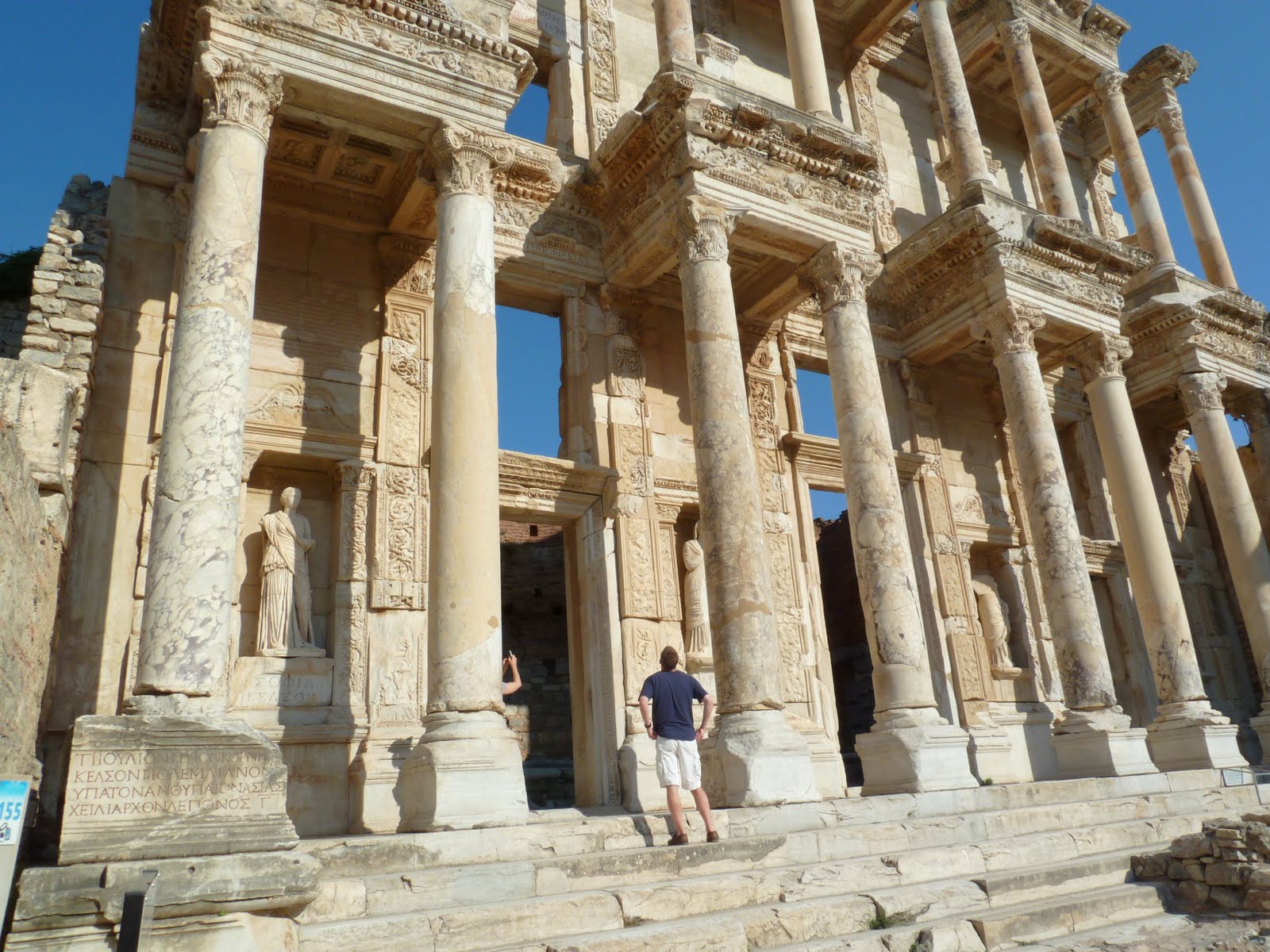
During the next part of the trip we traveled down the so-called Turkish Riviera, starting near the world heritage site of Ephesus. As a Catholic it was an amazing experience to go to holy sights, In this part of Turkey, including where St. John wrote his gospel, and the last residence of the Virgin Mary. We continued down the coast in searing heat, stopping to look at many ruins, to Bodrum, where we decided to go scuba diving. While the cargo plane we dove on was interesting, the reefs on the Turkish cost are rather dead, and thus don't attract many fish.

One of my favorite places on this trip was the small fishing village of Turunc, near Marmaris, a mess of a commercial tourist town. Turunc is popular with Polish and Russian tourists, so I had fun practicing with them while there. during this time we also spent a day on the Greek island of Rhodes. The old town was amazing. After having this experience I hope to go to Malta or some similar location.

From this point we continued south along the Mediterranean coast to Kas. While here we took a kayaking expedition over an ancient sunken city, one of the most interesting things I have ever done. The tour ended in a small, very undeveloped town. While the Lycian tombs in the area were interesting. one of the most amazing things I saw were the children stationed throughout the town, peddling various bracelets or articles of clothing. When someone was even remotely interested in the merchandise, other children who were previously on the other side of the town would quickly appear to compete for business. I have no idea how they know when someone they cannot see is interested in buying. Many of them also need a lesson in western business, as they seem to think that "getting there second" is a good selling point.

After a night in Antalya, we returned to Istanbul. There was an opera festival going on there. I decided to avail myself fully of the Turkish state opera's offerings. The first opera we saw was Rossini's "Mehmet the Second'. While the music was rather pedestrian, the spin that the Turkish opera put on it was quite impressive. The opera had the largest cast I have ever seen, complete with horses. The staging was unmatched insofar as sheer grandeur. I found the decision of the directors to stop the scored music, and have the Sultan make his entrance the way he actually would have, accompanied by the actual guard and band from the Topkapi palace, to be quite interesting. It was well the trouble to see this opera, in an outdoor amphitheater, during a rainy night. I also saw a Modern Turkish opera, in the Topkapi palace. It was interesting to see how the composer reconciled the conventions of western music composition with the technicalities of the Turkish language.

On our last day in Turkey, we found ourselves returning to the Blue Mosque. I found that after a month in this unique country. I looked upon it with greater appreciation.