Showing posts with label tourism. Show all posts

Friday, February 22, 2013

Democracy, Security, and Bodyguards

It was time to leave Tunis. We checked out of the hotel as our driver waited. The receptionist addressed us when we handed over our room keys. “When you go home,” she implored “tell people our country is safe!”
When I first heard her say these words I knew they would be the end of my blog post about Tunisia. We’d had an amazing experience.
The situation deteriorated the day after we’d left. Thousands protested in the streets. The prime minister resigned.
We were in Tunisia as the guests of my friend’s family.  Upon arrival they made sure we had an itinerary planned. They also saw to it that we were set up with a car and driver.
The first day we set out to see the ruins of Carthage, which is spread out through modern day Tunis.  The second involved a long car trip to the ancient city of Dougga. Then onward to the bi-level town of Bulla. On the third, we went to El Jem.  We all agreed that being able to walk the various levels of the amphitheater unrestricted made the experience superior to visiting the Coliseum.
 During the entire trip our driver, Ali, saw to it that we got admitted to archaeological sites without a problem. He made sure that we sample the local flavors of each town, market and roadside fruit stand. And he made very sure that we never had any trouble from street irritants.  Even on the warmest of days he never took off his heavy trench coat. We began to wonder if he was packing.
On the way back from El Jem, Ali got a phone call. He sounded agitated; we realized something was up.  Finally, my mother asked in French if there was a problem. He replied that one of their opposition leaders had just been shot by extremists.i
That evening we took dinner in our hosts’ home. They were unsure about what the immediate future would hold. “We are in transition” my friend’s father opined.
Indeed, conditions in Tunis seem to have worsened since the dawn of the Arab Spring. My family inquired about the trash in the streets, and the barbed wire near the old city. We were told it had become a fact of life since the revolution.  We also asked about our driver. It turned out he knew my friend’s father.  He didn’t have a gun. Yet, he’d been specially instructed to protect us.
The following day was our last in Tunisia. My friend’s father took us on a tour of the Marsa. He seemed cordial as we ate at his favorite restaurants and toured his friends’ shops . But, the atmosphere was tense.  Our driver seemed truly on edge for the first time. He parked below ground as we arrived.  At the end of the tour our driver and host’s father had an animated discussion. Then, we were driven directly to the seaport where we’d planned to depart late that evening.
While the protests in Tunis broke out, we visited Greek ruins in Sicily. Had we been in Tunisia on that day, I’m sure we would have been protected by our host family.
Can I honor the request of the hotel receptionist? Made even after the assassination?
I’m home. I’d like to say that I can.
But I can’t.

Friday, July 8, 2011

Greece: Crisis Averted?

During my most recent stint of travel, I had the opportunity to spend a day in Greece. While this country has not been in the news for a few weeks, I still feel it necessary to put in my two cents regarding the economic situation there. Admittedly, I was only there a small amount of time. However, I was immediately impressed upon my arrival at the contrast between the amount of private wealth in the area, and the obvious signs of a bankrupt government. Once you leave the old town of Rhodes, there is new construction everywhere. Many of the cars are luxury brands. On the other hand, almost all of the government run historical attractions on the island were closed until further notice. Many ancient ruins which are falling into unceremonious disrepair.
While the closed, dilapidated historical attractions did suggest the imminence of a debt crisis, it is important to remember that much of the private growth is being propped up by public spending. Any meaningful attempt at austerity would mean a great reduction in Greece' s standard of living. As a result, it is easy to see why there have been in the past, threats to recall any Greek member of Parliament who votes for such measures.
Since my visit, the Greek government did finally manage to obtain some agreement regarding austerity, in return for an EU relief package. However, it remains to be seen whether the government will follow through with their promise of responsible spending.
Even though an imminent debt crisis seems to have been averted for the time being, it has been my experience that people from euro zone countries have stopped trusting Greece, and in many cases the euro. Many either do not trust Greece to follow through on it's obligations, or have expressed regret that their country in the euro zone.
With the economic issues I had seen exemplified on the island of Rhodes still fresh in my head I left the Mediterranean for Krakow. Shortly after my arrival I found myself discussing the situation with a Slovak woman over dinner. "The dollar was so strong that we were happy to get the euro" she told me in Polish " Now Slovakia must pay for Greece's spending.

Thursday, July 7, 2011

Traveling through Turkey

I am currently in Poland and it has been a while since I have had time to blog. So before I forget some of the things I did while in Turkey I think it best to write them down and post.

On the first day in Istanbul, I set out to see the Blue Mosque with my family. It was here that we got our first introduction to how creative pushy salesmen can be in Turkey. Upon entering the mosque we were immediately accosted by a carpet salesman. He told us something about the history of the place and then insisted multiple times that we buy one of his carpets, even after we outright refused. This type of behavior was a problem throughout most of Turkey. It was impossible to stop at a restaurant or souvenir shop without being accosted. They only other place where I have encountered this type of hard sales technique has been in China. In my opinion this method of advertising can backfire, as we made a point of going only to the few restaurants that did not hassle us.

After while in Istanbul we also toured Hagia Sophia and many of the other mosques in the Sultanahmet area, as well as the Topkapi Palace.

The next stop on the trip was Cappadocia. It was a rather quick change of pace going from the bustling city to the the contorted fairy chimneys of Goreme. In many ways the small town was the exact opposite of Istanbul. The locals realize the tourists are their livelihood, and treat them with general respect. Even pigeons, which are considered to be nuisances in most major cities, are prized in Cappadocia for their soil-enriching droppings. It was interesting to see the plethora of different kinds of tourists that pass through this part of central Turkey.

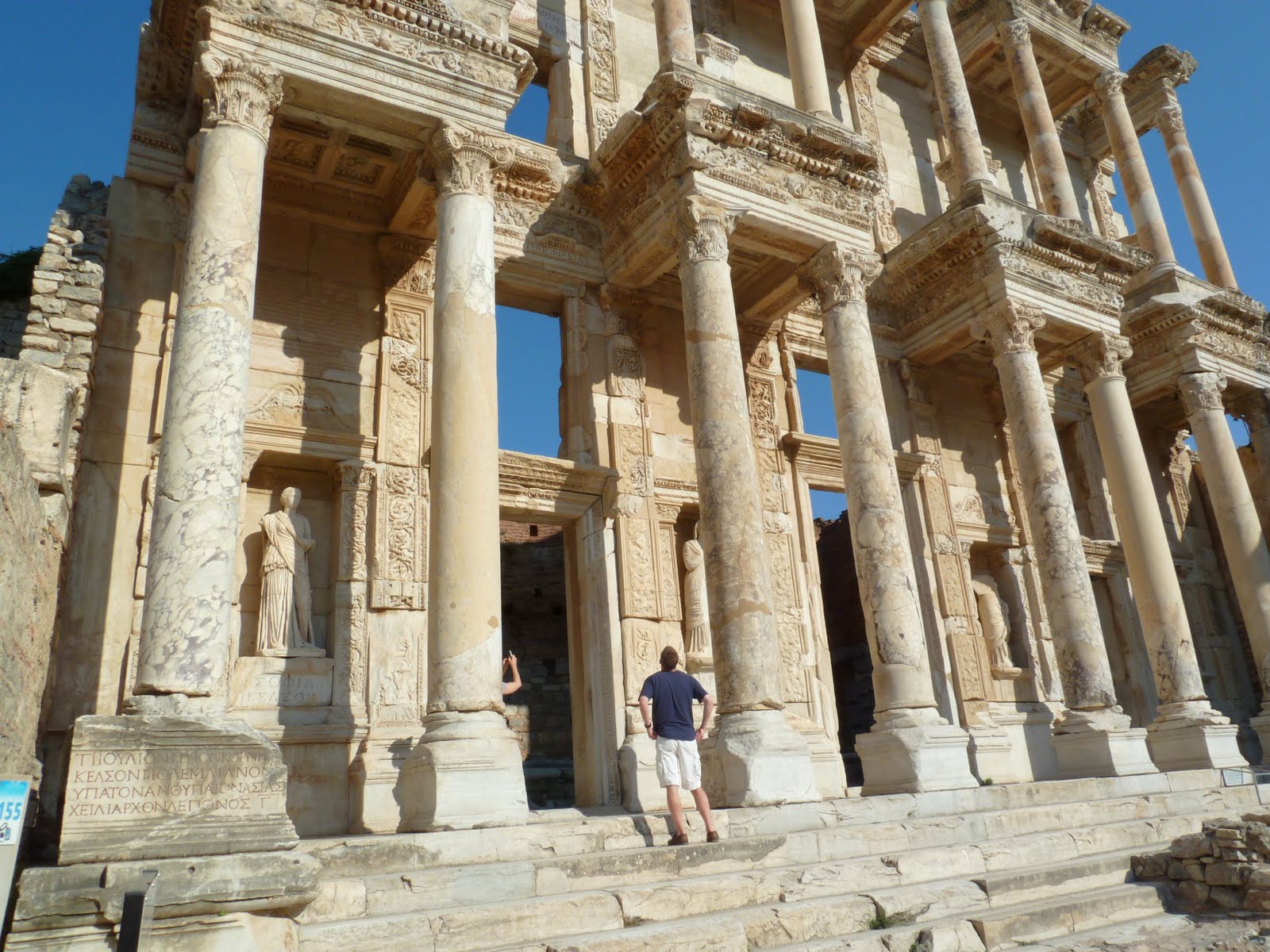
During the next part of the trip we traveled down the so-called Turkish Riviera, starting near the world heritage site of Ephesus. As a Catholic it was an amazing experience to go to holy sights, In this part of Turkey, including where St. John wrote his gospel, and the last residence of the Virgin Mary. We continued down the coast in searing heat, stopping to look at many ruins, to Bodrum, where we decided to go scuba diving. While the cargo plane we dove on was interesting, the reefs on the Turkish cost are rather dead, and thus don't attract many fish.

One of my favorite places on this trip was the small fishing village of Turunc, near Marmaris, a mess of a commercial tourist town. Turunc is popular with Polish and Russian tourists, so I had fun practicing with them while there. during this time we also spent a day on the Greek island of Rhodes. The old town was amazing. After having this experience I hope to go to Malta or some similar location.

From this point we continued south along the Mediterranean coast to Kas. While here we took a kayaking expedition over an ancient sunken city, one of the most interesting things I have ever done. The tour ended in a small, very undeveloped town. While the Lycian tombs in the area were interesting. one of the most amazing things I saw were the children stationed throughout the town, peddling various bracelets or articles of clothing. When someone was even remotely interested in the merchandise, other children who were previously on the other side of the town would quickly appear to compete for business. I have no idea how they know when someone they cannot see is interested in buying. Many of them also need a lesson in western business, as they seem to think that "getting there second" is a good selling point.

After a night in Antalya, we returned to Istanbul. There was an opera festival going on there. I decided to avail myself fully of the Turkish state opera's offerings. The first opera we saw was Rossini's "Mehmet the Second'. While the music was rather pedestrian, the spin that the Turkish opera put on it was quite impressive. The opera had the largest cast I have ever seen, complete with horses. The staging was unmatched insofar as sheer grandeur. I found the decision of the directors to stop the scored music, and have the Sultan make his entrance the way he actually would have, accompanied by the actual guard and band from the Topkapi palace, to be quite interesting. It was well the trouble to see this opera, in an outdoor amphitheater, during a rainy night. I also saw a Modern Turkish opera, in the Topkapi palace. It was interesting to see how the composer reconciled the conventions of western music composition with the technicalities of the Turkish language.

On our last day in Turkey, we found ourselves returning to the Blue Mosque. I found that after a month in this unique country. I looked upon it with greater appreciation.