Showing posts with label South Hills Estates. Show all posts

Sunday, August 25, 2013

Suspended Shoes. And A Dive Fin.

Not exactly the ghetto
 South Hills area is a pretty stable place. I grew up there. My upbringing afforded a background of education and culture. To say it provided a limited sense of street life is a gross understatement. I haven’t seen most other areas of Los Angles. But, I’ve been to countries that most US citizens will never experience.  To say it plainly, my life’s produced a person of sheltered bombast when it comes to some things. One who wouldn’t have it any other way. Look no further than this post for evidence.
Now, I’m going to talk about Belize. You could think that the above paragraph has nothing to do with this. Or that it served merely as an excuse to pontificate about my favorite subject. And you’d be right. At least in part. Belize isn’t South Hills. Nor is it Poland, Luxembourg, or Europe in general for that matter. It does happen to be located in Central America. That was about the extent of my expectations as I boarded the plane.   
Observing the cayes of Belize 
Upon arrival in Caye Caulker what I found reflected my concept of Caribbean island culture. This isn’t surprising. The place happens to be a Caribbean island.  Still, I found some aspects a bit novel. Caye Caulker attracts tourists. However, it remains relatively undeveloped.  The island has three dirt roads. There’s one stop sign and a few stores and street vendors. Pools are a rarity. The standard of living didn’t shock me. The way of life stood out.
It’s impossible to spend any time at all on Caye Caulker without noticing the prevalence of deadlocked bohemians who live there. ts also hard to ignore the presence of what can go along with them: marijuana.  I’ve spent time in countries where a third of the population is addicted to opiates. This was my first experience being anywhere near drug culture.
An island thoroughfare
 Drugs are illegal in Belize. Caye Caulker’s local constabulary expends great effort making this abundantly clear to anyone who visits by posting a sign on their office. We noticed the effectiveness of police measures from our fist day.
My mother worked as a reporter for many years. She’s been to some of the downtrodden neighborhoods that I’ve never seen. After our arrival she pointed out a pair of sneakers hanging form an electrical line. “That means you can buy drugs there” she educated. I looked around and noticed 6 other pairs suspended in front of various establishments. The practice seems so obviously unusual as to draw law enforcement attention. I’d still find in implausible if I could think of any other ostensible reason why one would wish to hang shoes from a utilities line.
The in-your-face-ness of it doesn’t stop there. After 8 at night it’s difficult to walk down the street without being propositioned to purchase some ganja. It’s so blatant that we thought it must be a police setup. Then we saw the substance changing hands between a dealer and a boy of about 10 years. If you want it. You can get it.      
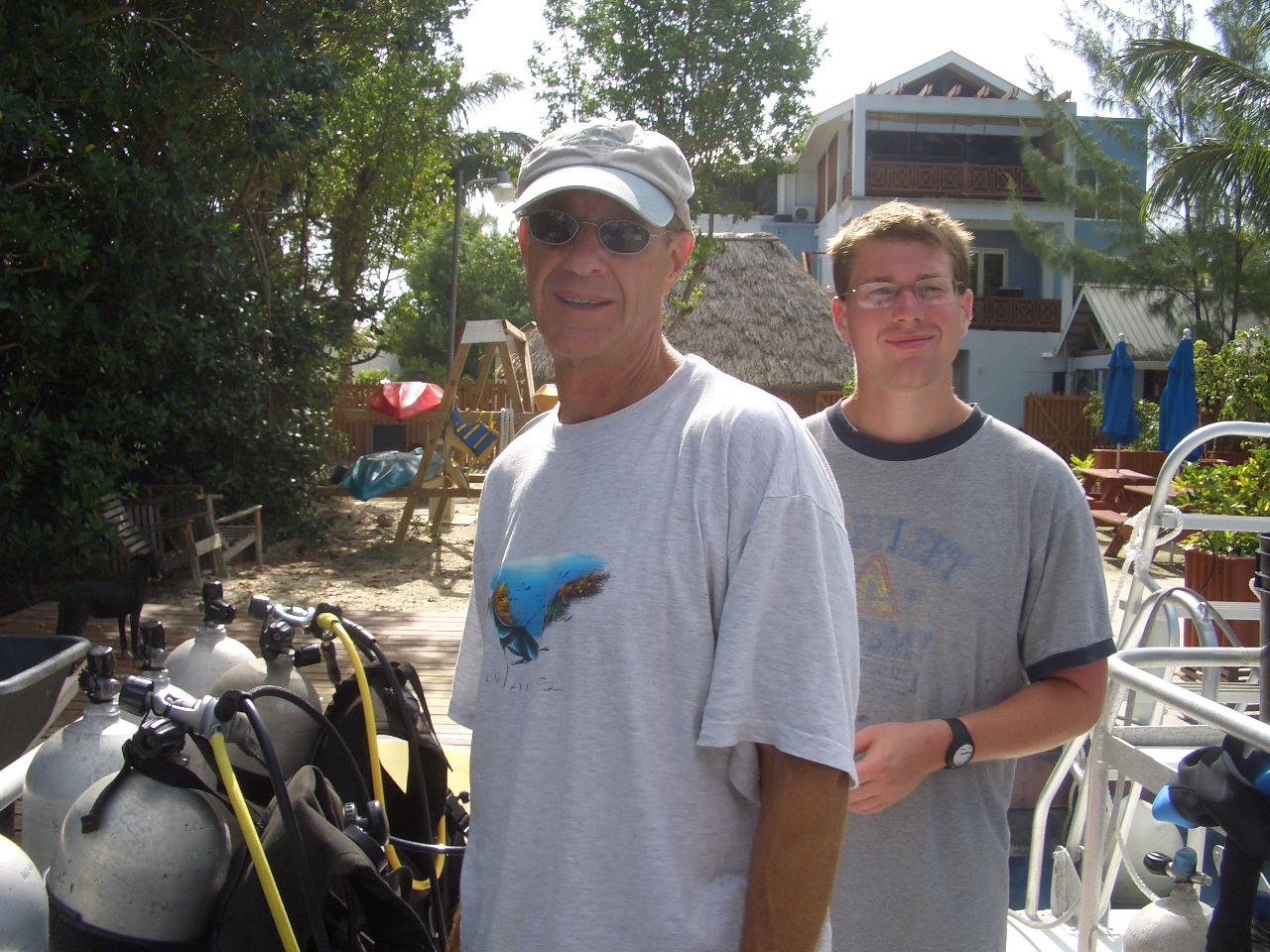
Heading to the Blue Hole
I ended up getting high before my time in Belize was up. No drugs involved. The diving is noteworthy. It can act like a drug. To produce aforementioned effect, take one Great Blue Hole and a dive tank. Descend past sharks to 135 ft. (40 meters). Remain submerged amid stalactites for roughly 6 minutes or until the nitrogen in your blood starts making this underwater world seem really slow and awesome. You can even add the Belizean booby reserve as a bonus afterword!  Minor side note: this process could possibly be incredibly dangerous and may include negligible side effects such as death. In fact, it would probably be a lot safer to just go back to Caye Caulker and smoke some weed.  Its not like the cops appear to care anyway.

View from the balcony
Don’t get me wrong. The ‘herbs’ aren’t the be all of Belize. The coast is beautiful and the diving amazing. The street vendors too relaxed to be pushy. The cuisine served seaside in front of peoples’ homes.  These aspects seem to coexist with the shoes hanging above it all. And yet, I keep waiting for the other shoe to drop. This life is positively unique; what I saw seemed real. Almost too real in a way. Unbelizeable, if you prefer the pun that’s used all over the island. I’ll always remember Belize’s teaming reefs and the tropical view from our 3rd floor apartment. But, what will always make Belize different in my mind is the bohemianness going on in the street below.  Its nice for a change. Especially when viewed by this sheltered know-it-all.   

Saturday, May 4, 2013

The Promised Land. An Undiscovered Country. And A-List Problems.


I thought my life would be better when my parents moved back to California. I’d spent my childhood there. We lived five years in Florida.  I thought things would go back to the way they were. They didn’t. Family members I’d known as nurturing accused me of being a spoiled traitor for enjoying travels to Poland, Russia and other foreign countries. During those past five years Walnut, CA had become a promised land. It didn’t measure up. I felt betrayed.
After that I never stopped traveling. My first home abroad was a dorm room in Beijing’s no.4 High School. I only had a roommate for a few days. He dropped out of our program. I was able to experience life abroad. The cafeteria’s bad food set me on a hunger strike after a couple of weeks. For the first time, I had my own friends; my own space.
Come to think of it, I’ve never had a roommate for an extended period of time.  I shared an apartment with family and acquaintances in Maldives. I took the multiple balconies and maid service for granted at the time. The interpersonal drama drove me up the walls. It also motivated me to journalistic success.
 I lived by myself in Bucharest too.  The apartment had an ionic view of the Palace of Parliament. I often reveled in it while cooking meals of my creation, or enjoying Moldovan wine. I dutifully cleaned the floors, and sprayed for cockroaches at midnight.  It took a visit from my mother to remind me that the place was a shit hole. No hot water. The balcony filled with standing water. Broken window panes.  Still, it was mine.  
During the latter half of that summer I lived in another dorm.  The impossible happened. My roommates were my best friends on the program.  We had some minor disagreements. But, our Polish courses finished after 6 weeks. As one of them put it: “it’s after two months that the drama starts to happen.” I’ve had the experience. I’m done with it.
At USC, I was forced to share an apartment for a year and a half. I had my own room. Yet, the situation was insufferable. Returning South Hills became a boon. My high school friends grew closer. I eventually moved back.  College became a necessary evil.
I’ve lived in other locales since then. There is something new you learn to appreciate in each city. Some more desirable than others.  In Budapest, I reveled in my flat’s grand piano, chandlers and short walk to the opera. In Bangkok, I lived on my balcony. I was forced to cook pizza with a hot plate.
Right now, I’m living in Poland. In a one bedroom apartment for what couldn’t buy a studio in the West.  I’ve never seen a roach. Everything works according to its Ikea design. I don’t need my mother to tell me that it’s not a shit hole. I dutifully vacuum my own floors.  I keep from my balcony for fear of unwanted solicitors.
Next year I’ll study in Vienna.  The best I can hope for is one room with no balcony. But, I know I'll live alone. Pursuing an uncompromising future. The rent will be more than for my Polish flat. The standard of accommodation will be less. I’ll learn to live with it. Yet, I now  realize what I’m embarking on.
I recently saw Verdi’s La Traviata.  In it, the protagonist’s father attempts to remind him of the pleasures his family’s home offers.          
 Our house is near Walnut. We call it The Village. I miss its multiple verandas. The effluent privacy;. its effortless cleanliness. Its manicured yards.  I hope its balconies shall always exist. That the friends I’ve made since Florida will be eternal.  I can’t help but long for the respite my summer return will bring. But what awaits beyond its premises?  
Once I leave my family’s home, my future can only be global.   
I must move ahead. Despite the difficulty. To improve my accommodations . To create The Village again in a new land. On my own terms.
Even if it’s impossible.          

Thursday, January 24, 2013

The Cold Reality


Winter in Poland can be tough. In a lot of ways it reminds me of Pakistan during Ramazan. The traffic sucks. Your days start before dawn and end after dusk. People seem to lose their cool for no reason whatsoever. You don’t even have to fast. The weather does it all for you. And, it lasts for more than a month!
I spent Christmas break at my family’s house in South Hills near LA. During that time, I never drove on a freeway or went to the store. I only ventured from my suburban community for our normal ski resort hegira. My life was a blur of old friends, new restaurants and timeless traditions.
Life seems harder after returning to Poland. Little things such as the going to the grocery store became arduous. Trudging through a mixture of snow and sand (why can’t they just use salt?) became almost unjust. I was ready to jump out of my skin after a third day of exam study in the same apartment.
The weather is part of it. The days are short; the temperature is well below freezing. This year is apparently heavy on snow. A simple errand involves freezing feet and fingers. Snow can turn bus schedules into a numerical farce.  I’ve heard that this climate affects one’s mood for the worse.
My family has often quoted an expression about life being ‘gray, sad and hard’ in Poland ten months out of the year. Indeed, on my last visit to LA life there seemed much more manageable.   In  Wroclaw, The view from my windows appears to be in grey scale. The snow and cold makes getting around a chore.
But how much of it is the weather?  January/February is exam period at the university. I can remember feeling the same annoyance in LA at having to study.  While in the U.S. during break, I didn’t have to attend class, pay rent, or stray far from home. Our usual ski resort was colder than Wroclaw at the time. The temperature wasn’t an issue. I was on vacation.
About a week ago, one of my friends was thinking about going home for the inter-semester break. A second-year colleague encouraged her. ‘Everyone will be so happy to see you’ she said. ‘They will ask you what you want to do, and take you to restaurants’.
Looking back, I remember that the reality of living in LA was different from visiting for a few weeks.  Commuting to collage for two hours each way drove me up the walls. Professional working conditions precluded any other lifestyle. The traffic sucked. No fasting or snow required.
 The regulatory environment was also stifling.  As one local student put it, at least ‘there are rules for getting around the rules’ in Poland.  Salaries are lower, but you get months of vacation. It’s a trade off.
There’s an eastern European expression: ‘Each day is worse than the day before, but better than the day after’.  In response, I can’t help but think of the Anglo phrase ‘that’s life’. And maybe that’s why we look forward to vacation so much. It’s better than life anywhere ever could be. An escape from the tests, the traffic, and the choices we’d rather not make.
In a week I leave for Rome, and the annual European family vacation. It’s only been 3 weeks since I’ve last had time off. Yet, I welcome the respite.   
No, it’s not just the weather.  No matter where you are, reality bears down; you long for a permanent way to escape. Even though one may not exist.
I stare out into the endless gray of night.  And think of the future.     

Wednesday, October 3, 2012

Required Reading


 In the past few weeks, many of my recent posts were about the attempt to find personal identity after being exposed to many cultures. I chalked my perspectives up to my own upbringing. I also considered the importance of each observer’s perspective in determining where each person is ‘from’.
Today, I started into my required university texts. I hit upon a theory of globalization that explains a lot. (Yes, I actually got excited by required course reading.)
Globalization “is visible in the emergence of a new economic class…whose members are separated from their fellow citizens by barriers of language, knowledge, wealth and tastes and to whom they may be physically proximate but psychologically remote.”
My cousin, uncle and grandmother live three miles from my parent’s home.  Ever since I was young I thought nothing of traveling the world. When America’s graduate school system wasn’t to my liking I imediately  looked abroad. My parents are both university graduates. My uncle never attended college.
About a year ago, I suggested that my uncle come visit me in Thailand. He informed me that he’d have to get a passport. I blanched involuntarily. I’ve held a passport since long before I had a driver’s license.  It never occurred to me that someone could lack such a basic document.   50-something years old and my uncle had never left the country.
In actuality less than 30% of Americans hold passports. Some of them are naturalized citizens.  
My little cousin says she never wants to leave the U.S. Believing that nothing could be better than the American way of life. But that lifestyle, and the quality of living in many other countries, has been bolstered by the power of trade.  She insists that she has no desire to learn a foreign language. I am proficient in two.   
The article also notes the association of this societal class with transnational corporations. My father worked with many of them as a mid and upper level manager during my upbringing. When I was about 13 my family was almost transferred to Switzerland. My Mother took many international assignments as a reporter. She currently runs an international media consulting company.
When I first wrote about South Hills, I attributed its difference from mainstream America to its existence as a subculture within LA. That may not be the whole story. I may be a member of this “new economic class” without realizing it. A member of a community comprised of successful, international families. Separated from the surrounding area by differences in language, ideology, wealth, and worldview. But, not so far removed as to be completely isolated from the surrounding local culture. 
Others claim that globalization leads to the erosion of local traditions. It enriches them. Born In America I had the curiosity to interpret Chinese proverbs. However, I find different meaning in them than a resident of mainland China. That native would doubtless have a different reading of an American film than its creators intended. Globalization is not simply American cultural imperialism.       
Other collage interns were employed at the NGO I worked with in Thailand. My closest friends were the 13 year old son of prominent Thai businessman and the 16 year old daughter of an international manager from Standard Chartered Bank. I attributed the age difference to my young colleges’ maturity at the time. Now I wonder if it was because we are from similar backgrounds. Based in nation-states. Citizens of the world.
In the current economic climate, some question the wisdom of globalization.  It’s a process that is beneficial to all concerned. Weather they realize it or not.
 As a product of this process I appreciate the importance of adaptation. The right to mold your own future.  To go where conditions are best. Despite those who are unaware of the possibilities.         

Thursday, September 13, 2012

City on a Hill


My friends say I live in a cat house. This isn’t because it’s in a slum. Cats like to be up high; its the two story living room you can look down on the activity.
Fog shrouds the valley
My family moved to the Walnut-South Hills area 5 ½ years ago. I spent many of my teenage years and early adulthood in this Asian suburb of Los Angeles. I’ve written about cultural experiences around the world. It seems only fair that I reflect on my own community.  
Every morning, from high school onwards, the first thing I’d do was open the shutters on one of my bedroom windows. Los Angeles expanded before me.  From the hills on which our house sat, it stretched through flats of tract housing towards distant freeways. The Sierra Nevada rose from the field below.
In many ways, the place I lived wasn’t anything like LA. It’s a mix of bareness and bounty. Paying an extra dollar for a premium blend at a pricy tea shop is a big decision. Many of my friends and I have traveled internationally, but never have been to Beverly Hills. This dichotomy of wealth and frugality can be shocking. It’s not uncommon to see a local washing his Mercedes in the driveway while gardeners mow a front lawn. We eat in crowded strip shopping center Korean restaurants for the best deals. We could easily go further afield.
And eventually we have to. The verity seen in more urban parts of LA isn’t available here. For culture, western food, and even education one must descend from the hills.  I got my undergraduate degree from USC in down town LA. Upon arrival, the culture I saw was different. Completely concerned with popular whims, it lacked the detachment I’d come to appreciate in my hilltop community.  I elected to remain in South Hills while studying at USC. 
One morning, I awoke, opened my shutters and looked down. Sunlight reflected off the cap of fog that settled over the LA basin.  Only the hills and mountains remained. I felt pride in having chosen to remain.
But my generation can’t remain forever.  A suburb isn’t the best place to launch a career.  Almost everyone in my closest group of friends is moving this month. One is possibly going to Britain, one to Germany, and one to that ‘other country’ called UCLA.
The field in Psie Pole
 I recently got on a plane, headed for Poland and graduate school. My route took me through Germany, the first European country I visited.   I boarded my trans-Atlantic flight in the first class cabin. One of its passengers was a 10-year old boy. He was likely on his first trip to Europe. I trudged into economy as he  played excitedly with his seat controls. That boy used to be me.  
The name of my Wroclaw neighborhood translates as Dog Field. It is also on the outskirts of the city. It’s flat as the name suggests. But, I’m still up high.  I stand on the balcony of my 4th floor apartment as the sun sets. A field still expands before me. Light reflects on its trees, stretching toward distant houses.  A blok rises from the meadow below.
 I’d like to think that these similarities are encouraging.  A sign that the life we’ve known still exists. That we will always carry it with us. No matter where we are.